
Numbers have always fascinated me, but sometimes they can be a bit misleading, even though accurate. In the stock market for instance, if you lose 50% ($1,000 down to $500), it then takes a 100% gain to get back to even at $1,000.
A similar thing is happening in the “megapixel race” to bigger and bigger sensors in our digital cameras.
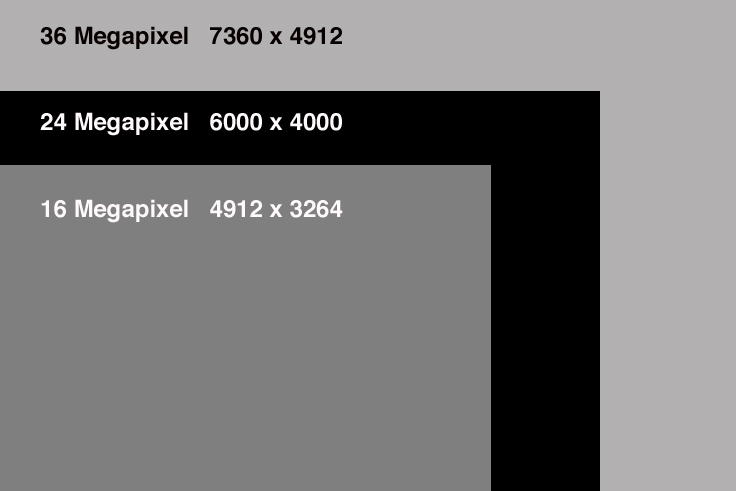
The new Nikon D800 boasts a 36 Mp sensor, which is huge(*see note) when compared to other currently available sensors. But just how much bigger is it? The image above show a comparison between three different sized sensors.
While the D800 sensor is significantly larger, at 50% more pixels than say the Sony NEX-7, that difference doesn’t translate into print sizes. In other words, at 300ppi, the 36 Mp image can print 24.5″ x 16.4″…the 24 Mp image can print 20″ x 13.3″. That’s only about 23% larger (dimensionally). The 16 Mp print would be 16.4″ x 10.9″, which means that the 36 Mp image only prints about 50% larger in spite of having well over twice as many pixels.
I don’t say any of this to detract from the D800…I would give my eye teeth to have one…however, I just find the numbers interesting in how they all fit together in different ways. It’s also interesting to note that, as sensors continue to increase in size, the jump in the number of megapixels will also have to get bigger to have a significant impact on print sizes. In order to get a print 50% than the 24 Mp NEX-7, the sensor would have to be 9,000 x 6,000, or 54 Megapixels!
So, start saving your money now for that next “super” computer you’ll need to be able to work with these huge files. $$$$
*NOTE: When talking about size, I’m strictly talking about resolution. The actual size of the Nikon D800 sensor is a normal “full frame” at 24mm x 35.9mm, while the Sony NEX-7 is an APS-C sized at 23.5mm x 15.6mm.
